

By Sam Tuliebitz, Head of Business Development
It’s taken me quite some time to write a follow-up to my last article (‘Tokenized Equities: What Do You Actually Own?’), but fortunately Robinhood’s announcement last week has provided some great fodder, and motivated me to invest some time.
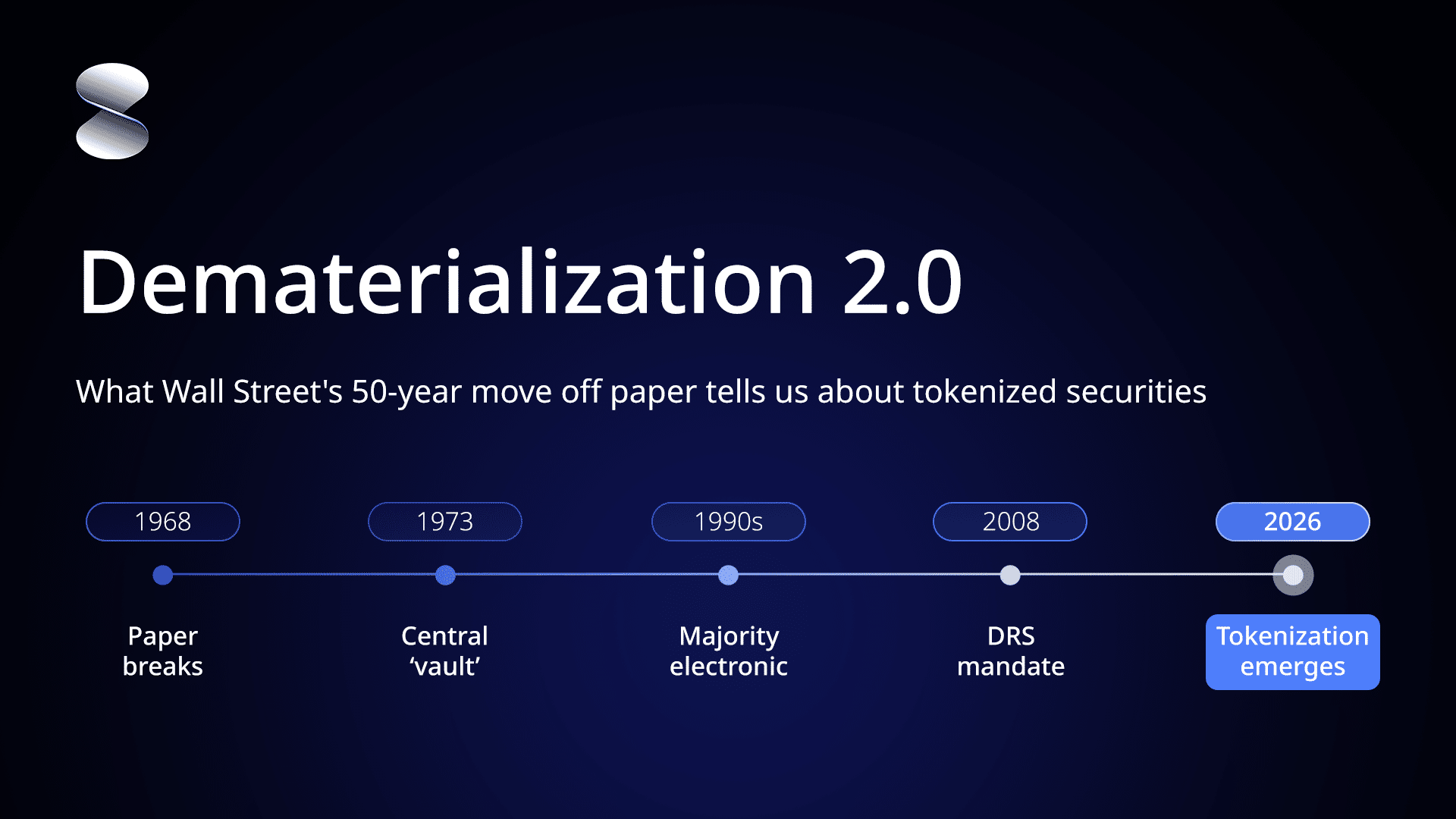
Here I will break down what was announced, how I read the implications (including a small bit on sec finance, as promised in my last article), and make the argument that we’ve unofficially begun ‘Dematerialization 2.0’. The last part carries an interesting paradox: the potential restoration of some of the features markets started with – bearer instruments and associated ‘composability’, only this time in a unified tech-driven marketplace running on hybrid rails.
What was announced
Among multiple announcements and progress updates, Robinhood has launched its own blockchain, aptly named ‘Robinhood Chain’, and a few new products to go along with it – including a new generation of stock tokens: Ethereum-compatible instruments, tradable 24/7 in more than 120 countries (pointedly, not the US, and subject to jurisdictional restrictions elsewhere). This is in addition to its existing regulated equity-exposure derivative offering through Robinhood Europe, now renamed ‘Classic Stock Tokens’.
Based on the public materials, the new product’s format and structure appear nearly equivalent to xStocks: retail tracker certificates – fully collateralized, open-ended debt securities issued by a Jersey SPV in tokenized form.
But there is one major difference in the product design, particularly around how it is distributed and its intended ecosystem from launch: it’s all DeFi, baby!
In its launch format, these stock tokens can be had via self-custody wallets, where they are initially priced against a dollar stablecoin (USDG) and executable via on-chain venues – automated market makers (AMMs) and request-for-quote (RFQ) market makers. Easiest to think of this as purchasing stock with stablecoin, but effectively a trading pair: USDG<>AAPLx. And because this is a self-custody setup, the trade itself takes place on no regulated market. Robinhood’s regulated entities are notably absent from the trade path: the issuer is a Jersey SPV, the sole authorized participant handling minting and redemption – the institutional gateway for creating and cashing out tokens – is Bitstamp lnc’s BVI arm, and the underlying shares sit with the SPV’s custodian. The token holder never owns those shares: their protection is a creditor’s claim against the SPV, routed through the structure’s contractual and security arrangements – not the ownership rights and investor protections that attach to holding the share itself.
To be fair, Robinhood has publicly signaled that redemption for the underlying shares is on the roadmap. The launch structure reads like a deliberate first version rather than the final one.
DeFi and regulation
I expect this statement to change with age, but in the current state: DeFi and securities regulation still don’t quite fit. Securities frameworks assume identifiable intermediaries at the point of trade, and DeFi is engineered to have none. Seen that way, the design choice arguably makes sense – if today’s rules cannot accommodate the product, build it in the open ecosystem that sits outside them. Thinking about this through an EU regulatory lens, it’s hard to believe this exact structure has a long shelf life. Then again, perhaps that is the point; shipping a working product may be the most effective way to engage regulators when no framework exists yet.
One end of a spectrum
I laid out the ownership question in detail last time, so here is the short version. Markets can tokenize toward two poles. At one end, the token is the security – issued or mirrored through regulated market infrastructure, where the unencumbered claim survives the failure of any single firm. Faith in the marketplace. At the other end, the token is a claim on an entity, and everything depends on the issuer, its custodian, and its balance sheet. Faith in a specific institutional value chain.
Robinhood built the second one. The trade path is disintermediated – on that front, the DeFi vision is closer than it has ever been. But the ownership claim still runs through trusted intermediaries; they have simply moved one layer down, from the point of trade to the issuer and its custodian.
The irony
Take a step back to recognize some historical themes here. Securities markets began with paper instruments that were portable, pledgeable and sometimes truly bearer. Even registered share certificates had bearer-like characteristics once endorsed and delivered: control of the paper mattered. The paperwork crisis of the late 1960s nearly broke Wall Street, so the industry spent decades immobilizing and dematerializing certificates into digital records held within a regulated market structure.
If the DeFi version of tokenization wins, we complete a loop. Whoever controls the token controls the claim. Freely transferable, self-custodied, bearer-style economics, sitting on top of a regulated and custodied underlying. Dematerialization 2.0 may, in fact, be a form of rematerialization. We spent fifty years getting rid of the risks and frictions of paper, and now we may be rebuilding some of its useful economics – but with modern technology.
Worth remembering, too, that paper had a primitive composability of its own. Certificates could be pledged, lent, or posted as collateral by whoever controlled the paper, with the benefit accruing directly to that holder. Coupons and warrants attached to a certificate could be cut and sold or pledged on their own. Intermediation made those functions safer and vastly more scalable, but it also moved a lot of the economics from the holder to the intermediary. Seen in that light, the tokenized composability arriving over the next few years is more of a restoration.
Two quick observations from a securities finance perspective
Once enabled, the DeFi token can be lent on a protocol. The underlying share, well, that depends. Supply the token (wrapper) to an on-chain pool and you earn DeFi yield; post it as collateral and you unlock a stablecoin loan. All the while, the underlying share sits in a custody account backing the structure. Two parallel lending markets form: one for the wrapper, priced by on-chain liquidity and governed by whatever the protocol says; one for the underlying, priced by traditional securities finance and governed by securities law and its investor protections (on behalf of the legal owner, which here is the SPV). The lending value of the underlying does not disappear. It accrues to whoever controls the custody account – and in practice, ‘control’ means being appointed the structure’s ‘Approved Prime Borrower’ – the firm the issuer designates to borrow the shares out of the structure. The SPV is a passive shell: no one in the structure appears positioned to advocate for market lending rates, or to disclose the on-lending economics of any future revenue share. Token holders should understand who fills that role.
To be clear, the structure does include a Swiss security agent – a firm appointed to represent investors’ claims on the assets backing the tokens – with a real job: hold that security package and enforce it if things go wrong. That is protection for the default scenario – not a mandate to advocate for holders while things go right. And the lending business is live: the Final Terms – the per-stock issuance documents – for flagship series (NVIDIA, for example) enable lending of the underlying from day one, with revenue allocated “in the manner specified on the Issuer Website, which may be updated from time to time.”
Lending itself is not my issue – lending assets you legally control is standard securities finance; it’s how holdings get monetized. My issue is who the paper is drafted for. Read the lending terms the way a beneficial owner’s agent would and they are strikingly borrower-friendly: collateral can technically be non-cash ‘eligible financial instruments’, nothing appears to require it to arrive before the shares leave, and no independent tri-party collateral arrangement of the kind an institutional lender would insist on appears in the disclosed structure. A negotiator acting for the economic owner would have demanded one line: collateral is either cash DvP (delivery versus payment), settled daily within US market hours – or tri-party governed non-cash HQLA (high-quality liquid assets). Nobody demanded it, because nobody sits on that side of the table – the legal owner is a passive SPV, the security agent is built for default rather than negotiation, and the token holders, the only reason the shares sit in custody at all, were never in the room. The issuer’s own risk factors acknowledge the consequence: whatever is out on loan no longer backs the products – the borrower’s collateral does. That collateral can itself include claims: cash or assets due, but not yet landed in the secured account. ‘Backed 1:1’ describes a portfolio of assets and claims – not a vault where your shares always sit.
This two-layer lending – the wrap and the underlying – is largely analogous to an ETF: the fund manager lends the constituents through an agent, while the ETF share itself sits opted into a retail broker’s FPL (fully paid lending) program and is lent into the market. The major difference is the control infrastructure. An ETF holder is a beneficial owner, and fiduciary duties and regulatory obligations run all the way down to the constituents. Here, the SPV owns the shares – and there does not appear to be an ETF-style fiduciary or agency chain running from the custody account back to the token holder.
And look at where those custody accounts actually sit. Behind the major tokenized stock products – xStocks and now Robinhood’s included, per the issuer’s own service-provider disclosures – sits the same regulated broker-dealer: Alpaca, which brokers and custodies the underlying shares and has become a central infrastructure provider in the still-nascent category. The ‘regulated underlying’ of this new bearer market currently runs through a very small number of licensed intermediaries. These firms have been genuinely innovative and have earned their early success.
Conclusion
Structures will evolve, but tokenization is happening either way. The tokenized equities market is still microscopic, but it is no longer theoretical. If the bearer analogy holds, history offers some wisdom: markets outlast noise, and the functions that matter – transferability, composability, the lending value of the asset – eventually migrate back onto regulated infrastructure; usually improved along the way, ideally with the full bundle of beneficial ownership democratized in the process.
Views are my own and not those of Sharegain. Nothing here is investment, legal, or tax advice, or a recommendation regarding any security or token. Analysis is based on publicly available documents (base prospectus, final terms, and issuer disclosures) as of July 2026; program terms can change. These are complex structures and my reading of them could be wrong in places – if you spot an error, send me a note and I’ll be happy to review.